Building it yourself
Measure the room’s inside dimensions, run the estimate above, then lay out walls and benches before you order.
- Lay out the room in SaunaDesignPro (opens in a new tab)
- Thermory USA installation guide (opens in a new tab)
Thermally modified aspen for saunas
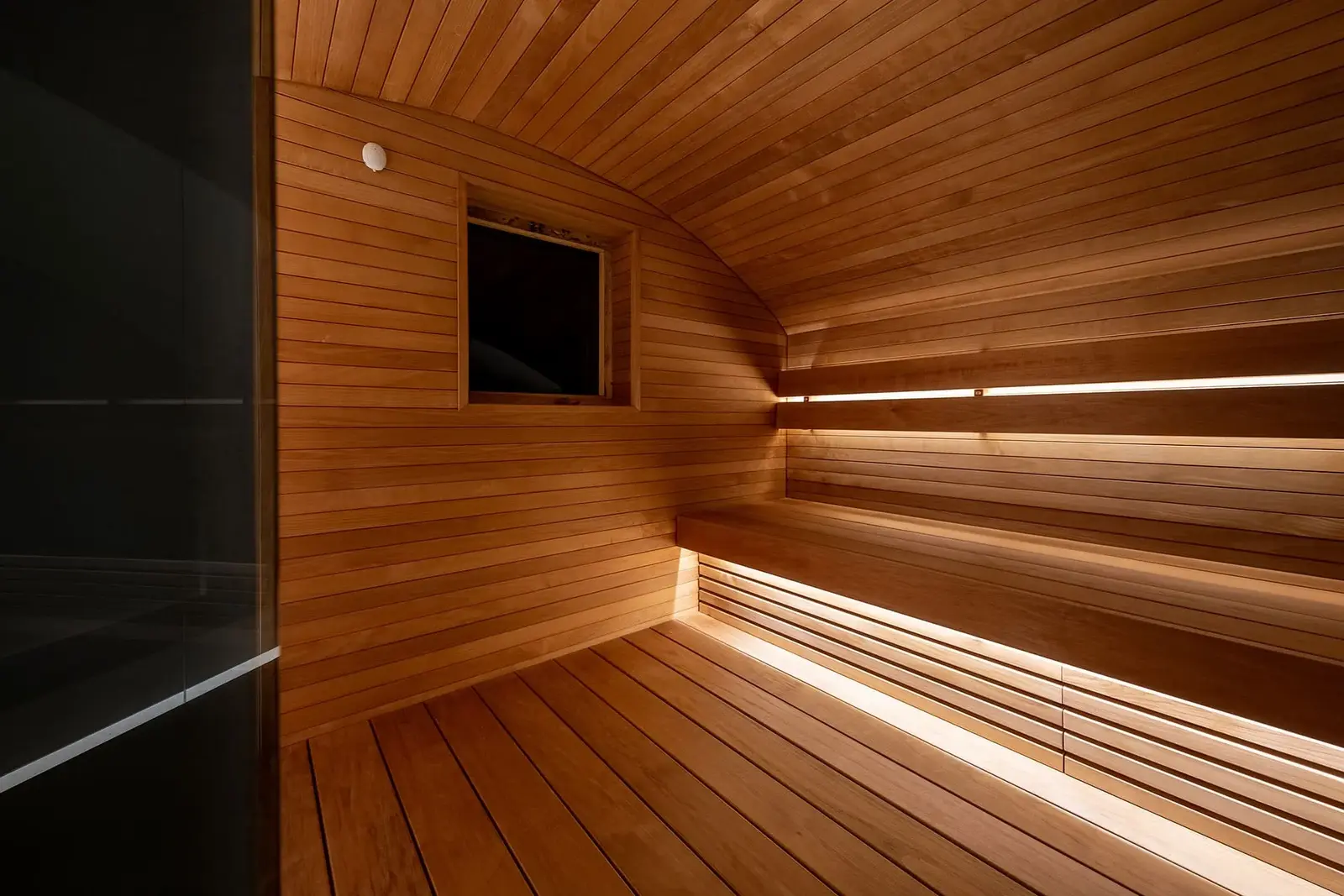
Thermo-aspen is thermally modified aspen: aspen boards treated with heat and steam in a controlled kiln. The process turns the wood a warm brown and makes it more stable through changes in heat and humidity. Thermory’s catalog calls aspen a preferred sauna wood because it is resin-free, smooth, and stays comfortably cool.
Source: Thermory catalog, pp. 4, 6
From Sauna Marketplace, which sells Thermory thermo-aspen. Shop thermo-aspen (opens in a new tab)
Industry test data (ITWA, mostly pine and spruce)
Test figures come from ITWA’s handbook, mostly on pine and spruce. For Thermory boards, use Thermory’s catalog. The handbook, from the International ThermoWood Association, lists aspen in both ThermoWood® classes but reports none of these values for aspen.
Plan your room
Multiply the net wall and ceiling area in square feet by 12, then divide by the board’s installed cover in inches. Add 5 to 10% for cutting loss, the range Thermory USA gives for wall paneling. STS4 1×4 covers 3.15 in, so each square foot takes about 3.81 linear feet before loss.
Coverage calculator
Estimated STS4 1x4
885linear feet
211 sq ft × 12 ÷ 3.15 in cover = 804 ft, plus 10%.
A first-pass estimate for wall and ceiling paneling only. Benches, trim, framing, and bundle rounding are separate, and the manufacturer's drawings govern the installed cover.
 STEP 5/4×32.20 in installed coverStepped, with a deep square shadow at each joint
 VIRE 1×43.11 in installed coverSawtooth, with angled facets
 STS4 1×43.15 in installed coverFlat, with a slim groove at each joint
 KYTE 1×43.15 in installed coverRaised ribs with narrow grooves between them
 STS4 1×54.33 in installed coverFlat, with a slim groove at each joint, on a wider board
Cover widths come from the Thermory catalog. The swatches show each face’s texture, and Thermory USA notes slight shade differences between production batches, so check a sample before you order.
Sources: Thermory catalog, pp. 8, 9, 10; Thermory USA guide, p. 2
Before you build
Four details make or break a thermo-aspen room.
Two ways in
Measure the room’s inside dimensions, run the estimate above, then lay out walls and benches before you order.
Take profile sizes, installed cover, and fixing details from Thermory’s documents. Read the ITWA handbook as background on thermally modified wood.
Read the spec guideHow it’s made
Thermory USA says it tailors a separate process to each species by controlling temperature and moisture.
For its sauna materials, Thermory’s catalog describes a high-pressure chamber. The wood is heated to as much as 356°F while pressure rises to about 130 psi, with only heat and steam. Thermory says this controlled chamber lets the wood change without over-drying, which reduces internal stress and keeps cracking and warping to a minimum. Final color depends on the species, the temperature, and the time.
Sources: Thermory USA brochure, p. 3; Thermory catalog, p. 6
How thermo-aspen is made, step by stepFrom the journal
Multiply the net wall and ceiling area by 12, divide by the board’s installed cover in inches, and add 5 to 10% for cuts. A 5 by 7 foot room with a 7 foot ceiling and one door takes about 797 linear feet of STS4 1×4.
Read the articleCedar gives an aromatic, reddish room; thermo-aspen gives a warm brown one. How they compare on look, scent, feel on skin, movement, and care.
Read the articleThermal modification uses heat and steam to permanently change the wood’s color and how it takes up moisture. It stays aspen: soft, smooth, and fine-grained.
Read the articleNo. Thermal modification lowers how much water wood takes up, yet the ThermoWood® Handbook does not recommend ThermoWood® products for direct contact with soil or water. In a sauna, Thermory says to throw water only on the heater, not on walls or benches, and to keep it from pooling. After each session, dry the room with the heater on and the vent open.
Yes, a smoky scent, most noticeable when the sauna heats. The ThermoWood® Handbook says it probably comes from compounds called furfurals, and that it seems stronger than untreated wood’s even though VOC emissions are far lower. Thermory USA says the scent weakens over time but never disappears completely. Long heating with airing speeds that up, and a suitable wax or maintenance product can reduce it.
Yes, gradually. Thermory USA says wooden sauna surfaces may darken over time, and faster where hot steam reaches them. A breathable protector applied before first use guards against moisture and dirt and makes cleaning easier, per Thermory’s catalog.
Yes. A sample shows tone, texture, profile depth, and machining under your own lighting. Thermory USA notes slight shade differences between production batches, so treat the sample as a guide and check the delivered order before cutting.